The New CMO: Building the Intelligent Growth System
By Michael Donovan ·
Designs, builds, and operates an interconnected recursive system for sales and business growth.
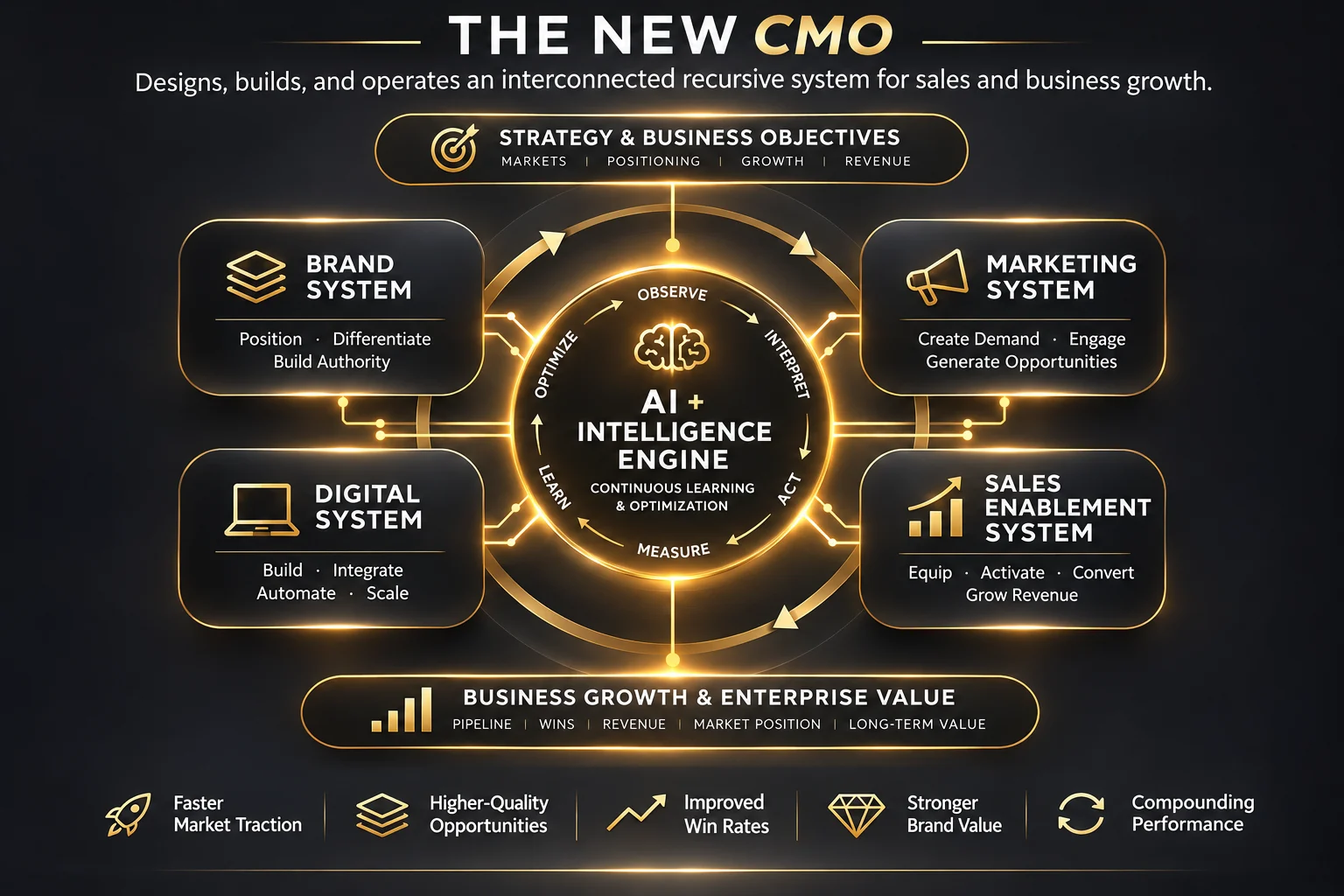
An intelligent growth system designed to improve through use.
Four interconnected operating systems, Brand, Marketing, Digital and Sales Enablement, work together through a central AI-powered intelligence engine. Market signals become insights. Insights inform decisions and actions. Results generate new intelligence that feeds back into the system, continuously improving performance and revealing new commercial opportunities.
The result is more than a better marketing operation. It is an evolving business capability designed to strengthen competitive advantage, generate revenue opportunities and build enterprise value.
For decades, the chief marketing officer has been defined largely by the functions under their responsibility.
Brand strategy. Advertising. Communications. Market research. Demand generation.
The tools have changed dramatically, but the basic operating model has remained surprisingly familiar. Marketing develops the strategy, creates the campaigns, manages the channels and measures the results.
Technology has made much of that work faster. Artificial intelligence is now accelerating it further.
But improving the speed of individual marketing activities is not the same as improving the intelligence of the business.
That distinction is becoming increasingly important.
The opportunity for today’s CMO is not simply to produce more content, automate campaigns or extract greater efficiency from existing marketing budgets.
It is to design and operate an interconnected business growth system in which intelligence, technology and commercial execution continually reinforce one another.
The New CMO is not simply the executive responsible for marketing. The New CMO is an architect of business growth.
The New CMO doesn’t just manage marketing. The New CMO designs, builds and operates the systems that turn intelligence into business growth.
From managing functions to building systems
Most businesses already have the essential components of a growth operation.
They have a brand. They conduct marketing activities. They maintain digital infrastructure. They employ people responsible for generating and converting sales opportunities.
But these capabilities often operate independently.
Marketing may generate inquiries without knowing which ones become profitable customers.
Sales teams may discover important changes in customer needs without that intelligence influencing marketing strategy.
Digital platforms may collect enormous quantities of data that never inform a meaningful business decision.
And brand positioning may remain largely disconnected from the commercial opportunities the business is pursuing.
Each function can be reasonably effective in isolation while the business as a whole performs below its potential.
The problem is not necessarily a shortage of talent, investment or technology.
It is often a shortage of integration.
The New CMO approaches this differently.
Rather than treating brand, marketing, digital and sales enablement as separate responsibilities, they are designed as interconnected operating systems.
Each has a distinct purpose. Each contributes to commercial performance. And each becomes more valuable when connected to the others.
Four interconnected operating systems
The architecture begins with four fundamental capabilities.
The Brand System
Brand is the foundation of competitive positioning.
It establishes how a business is understood, why it matters and what distinguishes it from alternatives.
But brand is more than visual identity or communications.
It influences the markets a company can credibly enter, the customers it can attract and the value it can command.
An effective Brand System connects business strategy to market positioning, messaging and reputation.
It creates the conditions for commercial preference.
The Marketing System
Marketing translates positioning into market engagement and demand.
It develops content, builds visibility and creates opportunities for prospective customers to discover and evaluate the business.
Search, thought leadership, public relations and industry engagement become parts of a coordinated system rather than disconnected activities.
The objective is not simply to attract attention.
It is to generate relevant demand from organizations with a credible reason to buy.
And increasingly, the Marketing System should be informed by intelligence about emerging market needs, customer behaviour and commercial opportunities.
The Digital System
Digital infrastructure is where much of the New CMO’s operating model becomes possible.
Websites are no longer simply online brochures.
They can function as interconnected platforms for market intelligence, customer engagement and commercial opportunity development.
AI-powered research tools can monitor markets and identify emerging demand.
Visitor intelligence can reveal which organizations are engaging with particular subjects.
Knowledge platforms can help prospective customers evaluate complex solutions.
Automation can connect these activities and reduce the manual effort required to operate them.
The Digital System provides the infrastructure through which intelligence becomes accessible and actionable.
It also creates opportunities to develop proprietary capabilities that strengthen the business beyond any individual campaign.
The Sales Enablement System
The final operating system connects marketing intelligence with commercial execution.
Its purpose is not to replace sales leadership or assume responsibility for every stage of the sales process.
It is to make sales teams better informed, better equipped and more effective.
That means helping identify and prioritize opportunities, understand prospective customers and prepare relevant commercial materials.
It also means connecting sales outcomes to the intelligence generated elsewhere in the business.
Which opportunities progressed?
Which messages resonated?
What objections emerged?
Where did the company compete successfully, and why?
These insights are valuable far beyond the sales department.
When fed back into the broader architecture, they can improve positioning, targeting and future investment decisions.
AI is not the fifth system
One of the most important distinctions in this architecture is the role of artificial intelligence.
AI is not treated as a separate department, marketing channel or collection of productivity tools.
It is integrated into the operating model.
Its purpose is to strengthen the intelligence and capabilities of the four interconnected systems.
AI can help research markets, interpret information and identify patterns that might otherwise be missed.
It can support content development, opportunity qualification and commercial research.
It can also power specialized tools that perform recurring tasks and connect information across the business.
But technology alone does not create an intelligent organization.
A collection of AI applications is not a growth system.
The real advantage comes from designing how information moves between capabilities, how decisions are made and how outcomes improve future performance.
That requires architecture.
It also requires human judgment, appropriate oversight and a clear understanding of business objectives.
The recursive path to continuous improvement
The defining characteristic of this operating model is its recursive design.
In simple terms, the system uses what it learns from its own activities to improve subsequent decisions and actions.
Consider a business operating in a specialized industrial market.
An AI-powered intelligence tool identifies an emerging project opportunity before a formal procurement process begins.
That information reaches the marketing and sales teams.
Marketing develops relevant technical content. Sales receives intelligence about the prospective customer and project requirements.
Digital systems monitor engagement and identify additional signals of interest.
As the opportunity progresses, the business learns which information matters to the customer and where its competitive advantages are strongest.
Those findings can then inform future research priorities, positioning and marketing activities.
The next opportunity benefits from what was learned during the previous one.
This is the recursive principle:
Observe. Interpret. Act. Measure. Learn. Optimize. Repeat.
It is important to distinguish a recursive architecture from an automatically self-improving one.
The feedback mechanisms must be deliberately designed. Data quality matters. Human oversight remains essential.
Not every activity produces useful intelligence, and not every automated decision improves performance.
But when the feedback loops are properly constructed, the business develops a more systematic way to learn from its operations.
Over time, that capability can become a meaningful competitive advantage.
Beyond efficiency: creating new commercial opportunities
Much of the current discussion about AI focuses on productivity.
How much faster can content be produced?
How many administrative tasks can be automated?
How much time can be saved?
These are legitimate questions.
But they address only part of the opportunity.
The more consequential question is what a business can now accomplish that it could not accomplish economically or effectively before.
A company may be able to monitor hundreds of procurement sources rather than a handful.
It may be able to identify prospective customers based on emerging needs rather than waiting for an inquiry.
It may be able to build specialized knowledge platforms that support customer decisions at a scale previously beyond its resources.
It may be able to recognize commercial patterns across markets that individual employees would struggle to monitor consistently.
These capabilities can expand the company’s commercial reach.
They can also create new organizational assets.
A proprietary intelligence platform, a well-developed knowledge system or a highly effective digital acquisition capability may have value beyond the immediate opportunities it generates.
Such assets can strengthen competitive positioning and reduce dependence on individual employees or external service providers.
Whether they increase enterprise valuation depends on their durability, ownership, economics and contribution to future earnings.
But the strategic possibility is significant.
The New CMO is not simply looking for better ways to market the existing business. The New CMO is helping build a more capable business.
The difference between strategy and execution
There is another important dimension to this model.
The distinction between developing a strategy and building the capabilities required to execute it.
Businesses frequently engage consultants to identify opportunities, recommend technology or develop growth plans.
Those recommendations can be valuable.
But implementation often requires another team, another supplier and another investment cycle.
The New CMO model brings strategic thinking closer to operational development.
The executive responsible for the growth architecture is also capable of designing the workflows, building or directing the development of digital tools and operating the resulting systems.
That does not mean the CMO personally performs every task.
It means taking responsibility for the coherence and performance of the architecture.
The ability to move between executive strategy and practical implementation becomes a defining capability.
And as AI reduces some of the technical barriers to developing sophisticated tools, that combination becomes increasingly attainable.
A different measure of marketing leadership
Traditional marketing metrics remain important.
Visibility matters. Engagement matters. Qualified inquiries matter.
But none provides a complete measure of the value created by an integrated growth system.
The broader questions are commercial.
Is the business identifying more relevant opportunities?
Is it developing a stronger competitive position?
Are sales teams better equipped to convert demand?
Are digital capabilities reducing operating costs or expanding market reach?
Is the organization becoming more effective at learning from its own activities?
And ultimately, are these improvements contributing to sustainable revenue growth and enterprise value?
Those are questions that connect marketing leadership directly to the priorities of the CEO, CFO and ownership.
They also require more disciplined measurement.
A stronger architecture does not guarantee revenue growth. Market conditions, product competitiveness, sales execution and customer economics still determine outcomes.
The objective is to create better conditions for commercial success and a more effective way to improve performance over time.
The New CMO
The future of marketing leadership will not be defined simply by who adopts the most AI tools.
Nor will it be defined by who produces the most content or automates the greatest number of tasks.
The more important distinction will be between organizations that use technology to improve isolated activities and those that use it to build integrated business capabilities.
The New CMO has an opportunity to lead that transition.
To connect brand positioning with market intelligence.
To connect marketing activity with commercial opportunity.
To connect digital infrastructure with sales execution.
And to ensure that the intelligence generated throughout the business contributes to continuous improvement.
The result is not merely a more efficient marketing department.
It is an interconnected growth architecture designed to become more capable through use.
One that can improve existing operations while identifying new sources of revenue and competitive advantage.
That is the recursive path to continuous improvement, new revenue opportunities and enterprise value.
And it represents a more expansive definition of what a chief marketing officer can contribute to a business.
Fractional CMO Services & Scope
Don't Hire a CMO to Manage Your Marketing. Hire One to Improve Your Business.
Why Choosing the Right Fractional CMO Matters More Than Choosing One